
Musical Adventures is an introduction to music in its many forms. This engaging program is designed to enhance a child’s creative development through the love of music and to help build a foundation of intellectual and social skills. Each session will include singing, instruments, movement and listening activities. Join us to get musical this term!
Music programs should be fun and engaging – as they are most often geared to our youngest participants. Lessons should involve many elements – from listening and dancing, to music creation and the intersection of music with other arts or mediums, to learning to rehearse and perform — and of course, time spent learning to love music in all its forms. When planning a music lesson, plan multiple activities each week to hold the attentions of young students – move from active elements to more quiet moments – and always be ready to “switch it up” to appeal to your audience. A great trick in music programs is to find out what the group loves (often times a game like “Freeze Dance” or a quiet activity like music-inspired colouring) and save that for the end of each class. Once the ‘lesson’ is complete and clean up is done, students can be rewarded with this favourite element – a sure way to make everyone happy every class.
See the Musical Adventures Packing List here.

Suggested lessons for this program are as follows – remember to combine lessons and elements in each class to keep your group engaged. Please email Liz if you’d like more information/ideas/help planning:
Camp Songs: Teach your group camp songs or ‘repeat after me’ songs to help them gain an understanding for the call-and-response style of learning a song. Have them focus on listening carefully so that they can repeat both the tempo and the notes and words back to you with accuracy.
Musical Theatre: Teach your group a song from a musical theatre show. Focus on shows which have had live stage runs on Boradway or the West End, so that you can build on the lesson and highlight the magic of the theatre and the intersection of music, dance, singing and acting in this art form. Start by learning a simple song and – if your group enjoys it, try adding movement and/or percussion instruments to it in a future week! Note that Explore It! has a wealth of edited musical theatre tracks to support you in this lesson – pre-edited to be short, simple and easy to teach and learn. Email Liz to find out more.
Explore Instruments: Hand out percussion instruments to your students and have them make some noise! When you are tired of the noisy chaos, play some games with your students such as Pass the Beat, where students come up with a short melody using their instrument, and the next person in the circle repeats it until it has moved all the way around. Three Different Sounds encourages students to use their instrument to create three unique sounds. On a triangle, that might be hitting it with a mallet, hitting it with a mallet when your hand is muting the sound and hitting the triangle against the floor. Grow the Music has students begin a beat, and then pass it to the next person who must add to the beat, until it makes it all the way around the circle, getting longer and longer.
Musical Words: Introduce your students to a variety of words for describing music. These words can fall into two categories, emotional and technical. Begin choosing a genre of music such as classical. Play a variety of songs for your students at a variety of tempos and emotions. After each selection have your students describe the music in terms of how it makes them feel. Ask if they can decipher the speed of the music or describe it in other ways. Make a list of these terms and steer students towards terms they haven’t thought of, widening their musical vocabulary. This activity can be done in the beginning of each program, choosing a different genre of music each class. Genres for exploration could include classical, jazz, pop, funk, rock n roll, world or global music and musical show tunes or music from children’s movies.
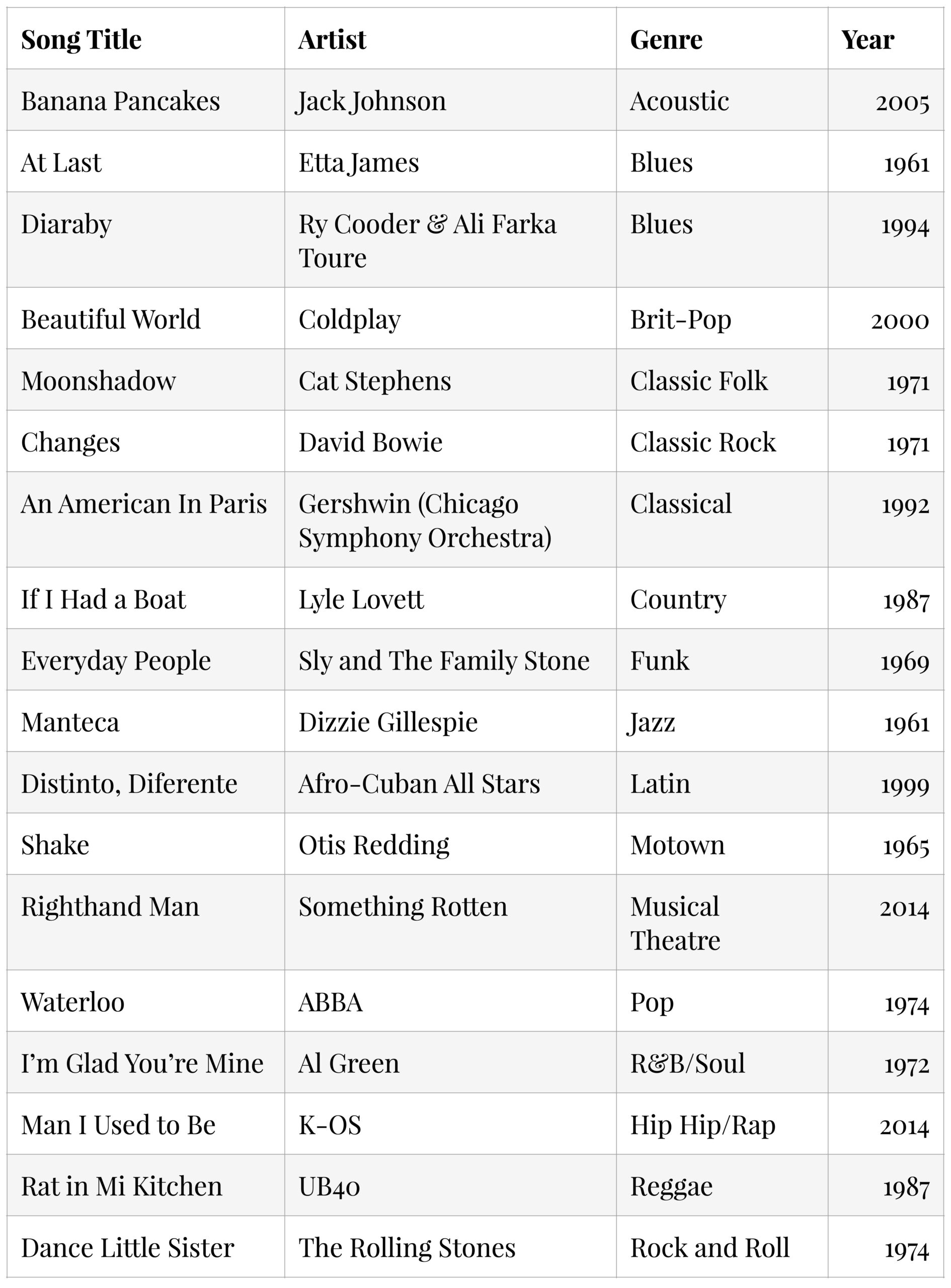
The Art of Music: See the list of music to the right, put together by Liz in a musical interpretation class which was originally run with kindergarten students. To recreate this lesson, students should be set up with paper and markers, and asked to draw the images that the music makes them think of. What’s most important is that the “emotion” of the music is focused on – not the quality of the art. To do this, ask students to create their art in under 1 minutes – then move on with the next song and a new piece of paper. It might take some coaxing and a few songs to get students in the swing of things – but with some encouragement, students will naturally find the intersection between art and music in this lesson. While working, or between songs, students might be asked if they think the music is “new/current” or “old”. Musical genres can be discussed and reviewed, and once students are familiar with the genres they can be asked to guess what genres different pieces of music fall into, and asked to relate certain pieces of music to other music they have heard, movies they have seen or experiences they have had. Run your own variations by choosing your own music, or use the music suggested in the list.
Music and Dance: Ask students to use their bodies to “describe” or interpret a piece of music. Begin in a circle and put on a piece of music, and asking your students to use their hands to describe the music. Change body parts and ask them to use their feet to describe the music. Continue to change, or add body parts until you have students up and using improvised movement to describe a piece of music. Build on this by choosing and setting movements from the group to create a dance piece, reinforcing listening, memory and gross motor skills!
Theme Days: Theme days such as songs about food, songs about animals, songs from your favourite movies or songs from the 1960s. Sessions run in this way may include a variety of different activity areas. It may begin with you teaching your students the Apples and Bananas song by Raffi, using hand movements to reinforce the movement. You might continue to use your voice, face and body to imagine a banana in different states, such as, “What does peeling a banana sound like? What does squishing a banana sound like? What does a rotten banana smell like? Etc.” Next, you could put on Banana Pancakes by Jack Johnson and have students listen to and draw pictures that the song makes them think of. Finally, you could chose to sing a second song about fruit like, “Go Bananas” or “Bananaphone.” The theme is BANANAS!
Musical Games: There is no end to the lists of musical games available online. Some resources are linked below – but feel free to research more! These games can be used as “carrots” to keep your students motivated or focussed throughout program, or can be used throughout the term when their themes or learning goals are complimentary to your session.
- 7 Engaging Games for Elementary Music
- 9 of the Best Music Games That Are Excellent For Kids’ Development
- 20 fun music games for the classroom
- 25 Fun Music Games for Kids
- Music Together, Musical Games
Musical Adventures Packing List
Additional items may be requested by emailing Liz at any time. Please give at least 1 week notice when requesting supplies.
| QUANTITY | ITEM | |
| PAPER | 1 folder | white paper |
| 1 folder | cardstock (colourful) | |
| 1 folder | construction paper | |
| 1 folder | large white paper | |
| PENCILS & PENS | 1 bag | pencils |
| 1 bag | pencil crayons | |
| 1 bag | markers | |
| MUSIC SPECIFIC | 1 bag | percussion instruments |
| 1 | bluetooth speaker and attachments |